When was the last time you visiting an Art Museum or Gallery?
Art Museums and Galleries are ranked according to the number of visitors. This popularity contest seems to designated the best art museums.
How many of these have you been to?
The top art galleries and museums in 2009, based on their annual visitor numbers are as follows.
1. 8,500,000 Louvre Paris
2. 5,569,981 British Museum, London
3. 4,891,450 Metropolitan Museum of Art
4. 4,780,030 National Gallery, London
5. 4,747,537 Tate Modern, London
6. 4,605,606 National Gallery of Art, Washington
7. 3,530,000 Centre Pompidou, Paris
8. 3,022,012 Musée d'Orsay, Paris
9. 2,763,094 Museo Nacional del Prado, Madrid
10. 2,730,204 National Museum of Korea, Seoul
11. 2,672,761 Museum of Modern Art, New York
12. 2,574,804 Taiwan Palace Museum, Taiwan
13. 2,426,203 State Hermitage Museum, St Petersburg
14. 2,273,634 Tokyo National Museum, Tokyo
15. 2,269,900 Victoria and Albert Museum, London
16. 2,087,415 Reina Sofía, Madrid
17. 1,961,843 National Portrait Gallery, London
18. 1,846,889 Art Institute of Chicago, Chicago
19. 1,840,812 De Young Museum, San Francisco
20. 1,572,171 Moscow Kremlin Museum, Moscow
21. 1,530,318 Galleria degli Uffizi, Florence
22. 1,513,249 National Museum of Western Art, Tokyo
23. 1,501,837 Tate Britain, London
24. 1,500,000 Mori Art Museum, Tokyo
25. 1,496,438 Musée Quai Branly, Paris
26. 1,451,139 Van Gogh Museum, Amsterdam
27. 1,368,096 Kelvingrove Art Gallery, Glasgow
28. 1,312,762 Art Gallery of New South Wales, Sydney
29. 1,300,000 Children's Museum, Indianopolis
30. 1,283,401 State Tretyakov Gallery, Moscow
I have been to five of these; Louvre, Metropolitan Museum of Art, Musée d'Orsay, Museum of Modern Art, and the De Young Museum. Looks like London would be a great place to travel inorder to view good art.
If you are interested in more statistics, including which art exhibits were most popular, you can find more information from The Art Newspaper's annual review of art galleries and museums and the exhibitions held around the world in 2009.
Thursday, April 8, 2010

Wednesday, April 7, 2010
Trillium Lane Video
I returned to the Chehalis Western Trail in Olympia, Washington with determination to capture the numerous Trillium on video.
A recap for new people.........
I have been amazed by the numbers of Trillium found in the forest near the Chehalis Western Train Head or End (depending on your perspective) at Woodard Bay. In my previous post I captured some of the Trillium with my camera. I have a short video capability on my camera and have been playing with that feature. For those Trillium lovers, I hope you can appreciate the spectacle of Trillium along the trail. In addition, I am expanding my learning curve by posting this video. Here's to the adage to learn something new every day!
Some interesting facts about the Trillium:
The Trillium is often the first wildflower noticed by casual walkers; other spring wildflowers are much less apparent.
In western North America, a typical species is Trillium ovatum (Western Trillium) also with white flowers, that slowly turn into a shade of purple in the middle of spring.
Picking Trillium for their flower can seriously injure the plant. The three leaves (more correctly leafy bracts) below the flower are the plant's only ability to produce food stores and a picked trillium can take many years to recover. For this reason in many areas, e.g. Michigan, New York, Wisconsin, Minnesota, and Washington, it is illegal to pick and/or transplant trilliums from public lands without a permit from the State.
Trillium is one of many plants whose seeds are spread by ants and mice. At maturity, the base and core of the Trillium ovary turns soft and spongy. Trillium seeds have a fleshy organ called an elaiosome that attracts ants. The ants extract the seeds from the decaying ovary and take them to their nest, where they eat the elaiosomes and put the seeds in their garbage, where they can be protected until they germinate. They also get the added bonus of growing in a medium made richer by the ant garbage.
I wish it were longer, but I hope you enjoy!
A recap for new people.........
I have been amazed by the numbers of Trillium found in the forest near the Chehalis Western Train Head or End (depending on your perspective) at Woodard Bay. In my previous post I captured some of the Trillium with my camera. I have a short video capability on my camera and have been playing with that feature. For those Trillium lovers, I hope you can appreciate the spectacle of Trillium along the trail. In addition, I am expanding my learning curve by posting this video. Here's to the adage to learn something new every day!
Some interesting facts about the Trillium:
The Trillium is often the first wildflower noticed by casual walkers; other spring wildflowers are much less apparent.
In western North America, a typical species is Trillium ovatum (Western Trillium) also with white flowers, that slowly turn into a shade of purple in the middle of spring.
Picking Trillium for their flower can seriously injure the plant. The three leaves (more correctly leafy bracts) below the flower are the plant's only ability to produce food stores and a picked trillium can take many years to recover. For this reason in many areas, e.g. Michigan, New York, Wisconsin, Minnesota, and Washington, it is illegal to pick and/or transplant trilliums from public lands without a permit from the State.
Trillium is one of many plants whose seeds are spread by ants and mice. At maturity, the base and core of the Trillium ovary turns soft and spongy. Trillium seeds have a fleshy organ called an elaiosome that attracts ants. The ants extract the seeds from the decaying ovary and take them to their nest, where they eat the elaiosomes and put the seeds in their garbage, where they can be protected until they germinate. They also get the added bonus of growing in a medium made richer by the ant garbage.
I wish it were longer, but I hope you enjoy!
Tuesday, April 6, 2010
Trillium Lane
Is it the Chehalis Western Trail Head or is it the Chehalis Western Trail End at Woodard Bay, Olympia, Washington?
For me since I always start at Woodard Bay, I think of it as the Chehalis Western Trail Head. The area is nestled in the trees and very picturesque.
For trillium lovers, this is the place! I have been amazed at the numbers of Trillium I have seen in the small area to the left of the main trail. Today I attempted to record a walk along the trail which I dubbed, "Trillium Lane" on my camera with the video setting. Unfortunately, not very experienced with my video setting on the camera, it came out sideways and I have not figured out how to turn it. Plus, now I have an idea of how it looks so that I can try again with better results. Next learning experience will be downloading it to my blog to share. Stay tuned.....
For a preview, here are some photographs along the trail:


This is my favorite spot as there are dozens of Trillium on
BOTH sides of the trail!

Bonus photo; Ebony and Trilliums

For me since I always start at Woodard Bay, I think of it as the Chehalis Western Trail Head. The area is nestled in the trees and very picturesque.
For trillium lovers, this is the place! I have been amazed at the numbers of Trillium I have seen in the small area to the left of the main trail. Today I attempted to record a walk along the trail which I dubbed, "Trillium Lane" on my camera with the video setting. Unfortunately, not very experienced with my video setting on the camera, it came out sideways and I have not figured out how to turn it. Plus, now I have an idea of how it looks so that I can try again with better results. Next learning experience will be downloading it to my blog to share. Stay tuned.....
For a preview, here are some photographs along the trail:


BOTH sides of the trail!
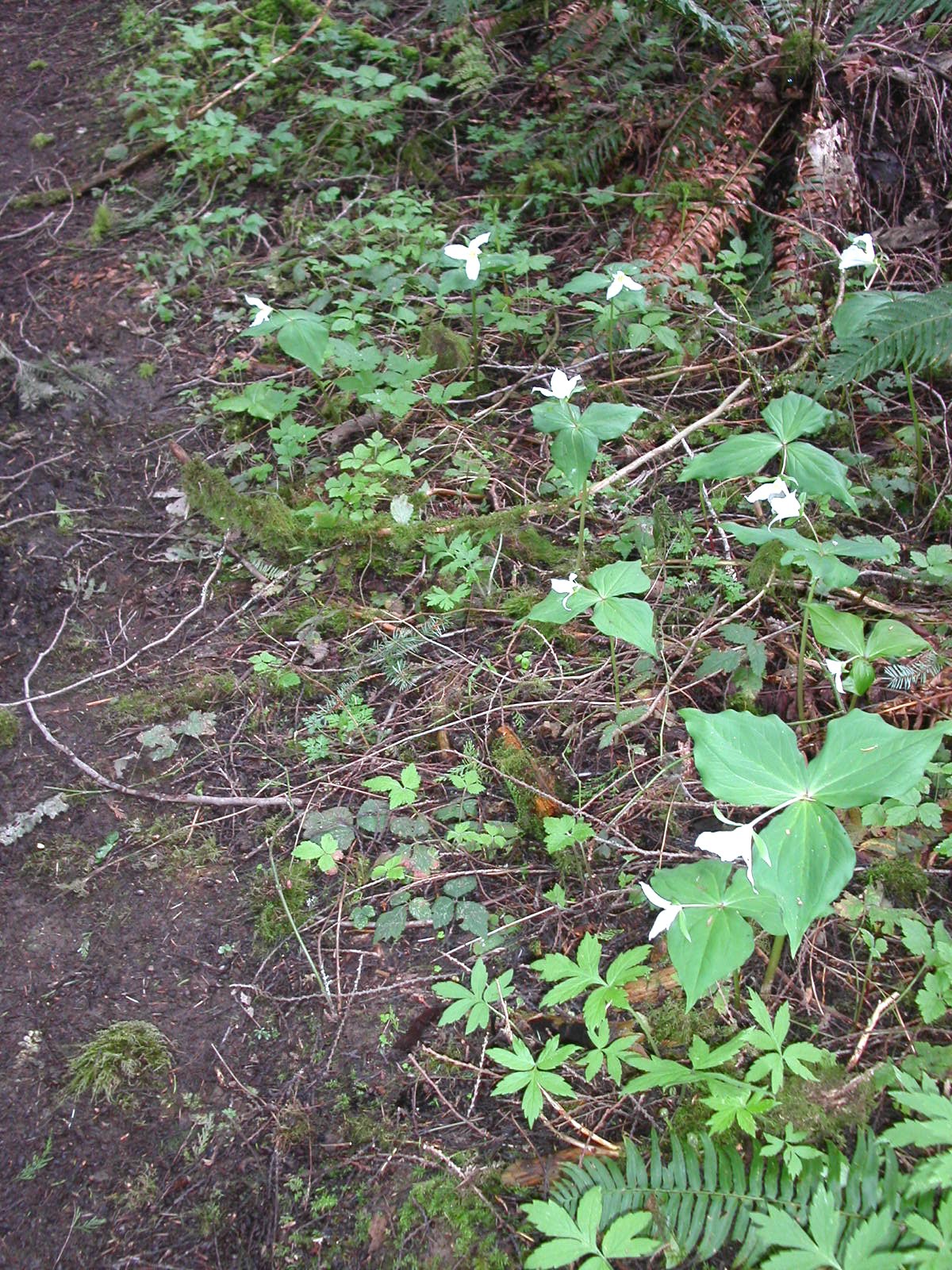
Bonus photo; Ebony and Trilliums

Monday, April 5, 2010
Latest Watercolor Painting
Feeling caught up with my house projects at the moment, I spent time creating another watercolor painting of water lilies........one of my favorite subjects.
Although this is the third rendition of this painting, each time it is a new experience. I went more colorful and if you look closer, I used the watercolor in layers actually getting paint thick as if using oils. What fun!

Waterlilies 3
Joanne Osband
I might be on to a new painting technique. Stay tuned.......
Although this is the third rendition of this painting, each time it is a new experience. I went more colorful and if you look closer, I used the watercolor in layers actually getting paint thick as if using oils. What fun!

Joanne Osband
I might be on to a new painting technique. Stay tuned.......
Sunday, April 4, 2010
Heron's Nesting
On February 25th, I blogged about the nesting grounds of the heron's at Woodard Bay near the Chehalis Western Trail and took a photo from my camera phone which turned out rather favorably.

Recently I had one of those sychronistic moments when I wanted to view heron's nesting before they closed the trail. The sign says the trail closes on April 1st; it was April 3rd but the gate was wide open.
Now, you must use a bit of creative viewing of these next cell phone photos as EVERY NEST has a heron in it.
Can you see them?
See their heads sticking out of the nests?


I was totally mesmerized! Then I thought I was going to get busted as a ranger came down the trail. Lucky for me he was checking for any people on the trail before he locked the gate. Barry told me about the rookery, the name used for the nesting grounds. The one here at Woodard Bay is the largest in Washington!
Talk about being in the right place at the right time!
Some interesting facts regarding the herons and their nests.
Usually, nests are about 1 metre in diameter and have a central cavity 10cm deep with a radius of 15cm. This internal cavity is sometimes lined with twigs, moss, lichens, or conifer needles.
Great Blue Herons normally nest near the tree tops. In colonies made up of several species, they will take possession of the top of the tree and leave the lower branches to other species.
In the spring, males and females reach the nesting grounds at about the same time. Males settle usually where there are nests from former years. Each male then defends his territory in the tree where he plans to build a new nest or restore an old one. From that site, males put on grand displays and shriek loudly when females approach them. New mates are chosen each year. Birds aged two years or more mate almost immediately upon arrival, usually at the nest or, when one is not available, on a branch.
The building of the nest soon follows. The male gathers nest-building materials around the nest site, from live or dead trees, from neighbouring nests, or along the ground, and the female works them into the nest. Ordinarily, a pair takes less than a week to build a nest solid enough for eggs to be laid and incubated. Construction continues during almost the entire nesting period. Twigs are added mostly when the eggs are being laid or when they hatch.
Most female herons lay from three to five eggs in April. Incubation, which is shared by both partners, starts with the laying of the first egg and lasts about 28 days. Males incubate during the days and females at night.

Recently I had one of those sychronistic moments when I wanted to view heron's nesting before they closed the trail. The sign says the trail closes on April 1st; it was April 3rd but the gate was wide open.
Now, you must use a bit of creative viewing of these next cell phone photos as EVERY NEST has a heron in it.
Can you see them?
See their heads sticking out of the nests?


I was totally mesmerized! Then I thought I was going to get busted as a ranger came down the trail. Lucky for me he was checking for any people on the trail before he locked the gate. Barry told me about the rookery, the name used for the nesting grounds. The one here at Woodard Bay is the largest in Washington!
Talk about being in the right place at the right time!
Some interesting facts regarding the herons and their nests.
Usually, nests are about 1 metre in diameter and have a central cavity 10cm deep with a radius of 15cm. This internal cavity is sometimes lined with twigs, moss, lichens, or conifer needles.
Great Blue Herons normally nest near the tree tops. In colonies made up of several species, they will take possession of the top of the tree and leave the lower branches to other species.
In the spring, males and females reach the nesting grounds at about the same time. Males settle usually where there are nests from former years. Each male then defends his territory in the tree where he plans to build a new nest or restore an old one. From that site, males put on grand displays and shriek loudly when females approach them. New mates are chosen each year. Birds aged two years or more mate almost immediately upon arrival, usually at the nest or, when one is not available, on a branch.
The building of the nest soon follows. The male gathers nest-building materials around the nest site, from live or dead trees, from neighbouring nests, or along the ground, and the female works them into the nest. Ordinarily, a pair takes less than a week to build a nest solid enough for eggs to be laid and incubated. Construction continues during almost the entire nesting period. Twigs are added mostly when the eggs are being laid or when they hatch.
Most female herons lay from three to five eggs in April. Incubation, which is shared by both partners, starts with the laying of the first egg and lasts about 28 days. Males incubate during the days and females at night.
Friday, April 2, 2010
Results of Second Nature's Rorschach Test

What do you see?
For those of you inclined to take the Nature's Rorschach test,
here is the result:
Do you see it?
The line coming down from the top is his forehead which feeds into the outline of his profile. He even has his paw raised against his face in a contemplative mood. He definitely is a happy character!
Do you see it now?
Anyone not familiar with a Rorschach Test here is some information:
The Rorschach test (also known as the Rorschach inkblot test or simply the Inkblot test) is a psychological test in which subjects' perceptions of inkblots are recorded and then analyzed using psychological interpretation, complex scientifically derived algorithms, or both. Some psychologists use this test to examine a person's personality characteristics and emotional functioning.
It is similar to finding images in clouds or in splotches of paint with or without the psychological interpretations.
Thursday, April 1, 2010
Another Nature Rorschach Test
About a week or so ago, I posted an image from my walk along the Chehalis Western Trail in Olympia, Washington. I called it Nature's Rorschach test because the image of the cut tree reminded me of a Rorschach test. At that time, I saw a face. Today, from a different angle the tree stump took on a different image.
What do you see?

For those of you who do not know what a Rorschach test is, I let me explain.
The Rorschach test (also known as the Rorschach inkblot test or simply the Inkblot test) is a psychological test in which subjects' perceptions of inkblots are recorded and then analyzed using psychological interpretation, complex scientifically derived algorithms, or both. Some psychologists use this test to examine a person's personality characteristics and emotional functioning.
It is similar to finding images in clouds or in splotches of paint with or without the psychological interpretations.
Stay tuned for the results of the New Nature's Rorschach Test
What do you see?

For those of you who do not know what a Rorschach test is, I let me explain.
The Rorschach test (also known as the Rorschach inkblot test or simply the Inkblot test) is a psychological test in which subjects' perceptions of inkblots are recorded and then analyzed using psychological interpretation, complex scientifically derived algorithms, or both. Some psychologists use this test to examine a person's personality characteristics and emotional functioning.
It is similar to finding images in clouds or in splotches of paint with or without the psychological interpretations.
Stay tuned for the results of the New Nature's Rorschach Test
Subscribe to:
Posts (Atom)


