Showing posts with label Chehalis Western Trail. Show all posts

Thursday, April 18, 2013

Nature Rorschach Test

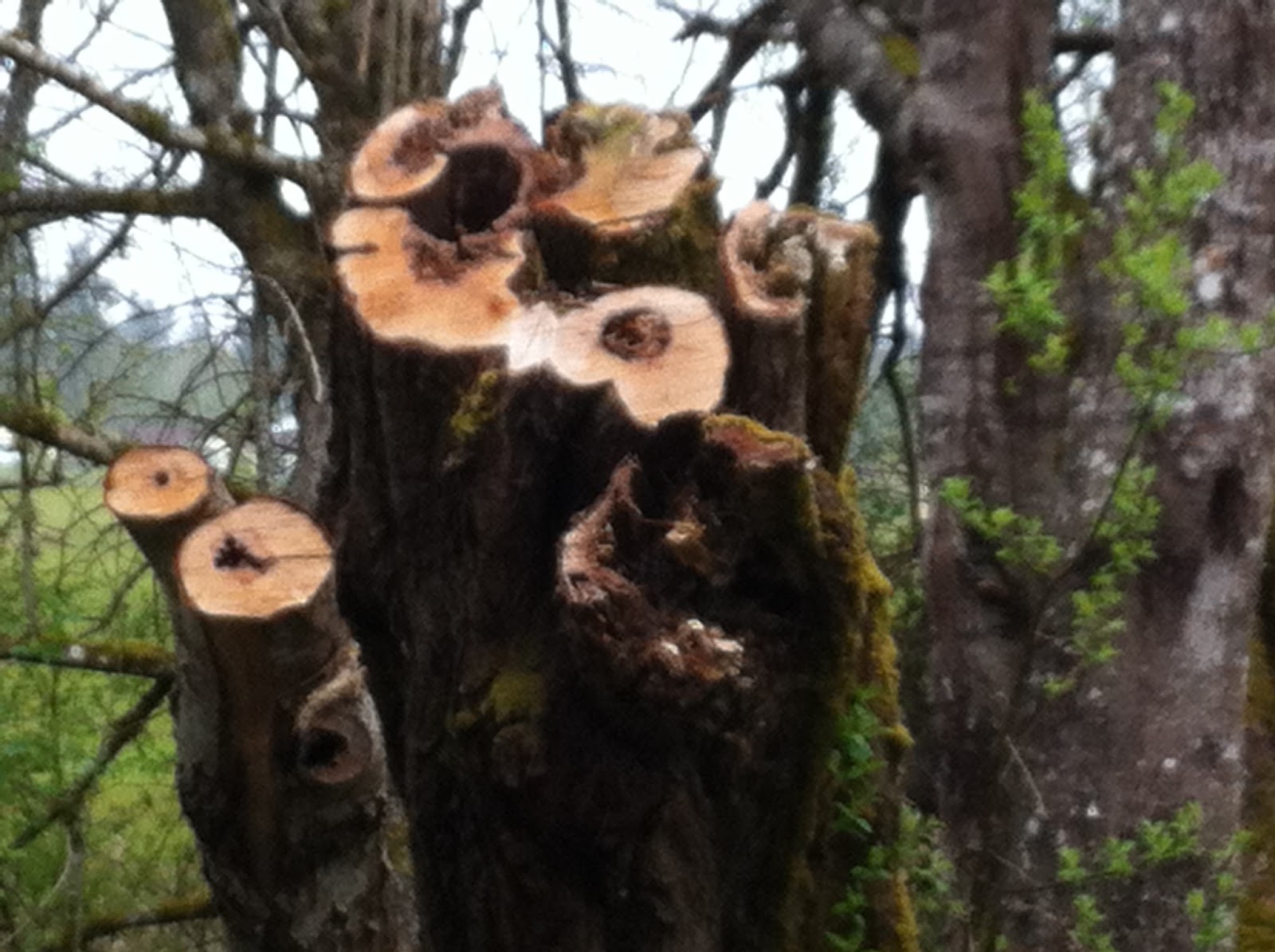
Once again on my daily walk on the Chehalis Western Trail in Olympia, Washington, I came across a "nature Rorschach test".

Let's see if you see what I see.........

For those of you who are not familiar with a Rorschach test, it is a psychological test in which subjects' perceptions of inkblots are recorded and then analyzed using psychological interpretation, complex algorithms, or both. Some psychologists use this test to examine a person's personality characteristics and emotional functioning.

What do you see in this cut section of tree?


How about an owl face?

Sunday, December 9, 2012

Sunday Sketches

The other day, my favorite place to walk my dog, the Chehalis Western Trail, had been cleared of leaves. I realized it was a metaphor relating to having a clear path and it appeared that everything along the path was inviting and beautiful.

When I returned home, I decided to create a mandala capturing this walking meditation. I started by painting a colorful path across the circle and then added some of my experience. I felt the need for words and let them flow along the path.

Walking Mandala
watercolor
18" X 24"
More Sunday Sketchers.....

Friday, October 26, 2012

Trees Take Two

The other day I completed, or thought I had, a sketch of the maple trees along the Chehalis Western Trail. I was not totally satisfied, but posted it on Sunday Sketches which is a group of artists who post art each Sunday as a weekly discipline.

It looks like this.......

And I complained that the computer over did the blues.

Well that was truly not the issue!

VALUES!!!

No values! A classic mistake which can make the difference between a good painting and a mediocre one.

I believe I fixed the sketch and the computer was cooperative.

What do you think?

BTW, for those of you who are not artists, value is an element of art that refers to the lightness or darkness of a color.

Saturday, January 29, 2011

Addendum to the Mystery Person

Recently I blogged about the mysterious person who creates rock sculptures on the mile sign posts on the Chehalis Western Trail in Olympia, Washington.

Having returned from a skiing trip to Whistler, British Columbia, Ebony and I are back walking the Trail. I found two new rock sculptures by our artist. Both of which are worthy of distinction.

The first one includes EIGHT rocks and I believe to be the most elaborate of those created.


The second rock sculpture has a nice clean balance and look to it.


I will continue my surveillance of the Trail for the artist.
Stay tuned.......

Saturday, January 1, 2011

New Year's Day

Another glorious, but cold, day in Olympia, Washington. I could NOT stay indoors. But unlike yesterday, Today I put on sunscreen.

Imagine, sunscreen in January in Washington!

Our early morning walk was on the Chehalis Western Trail, where my friend, Linda, and I came upon a ruby-crowned kinglet feeding on the side of the trail. The bird was frantically looking for food in the frozen foliage and did not care that we were so close to it. I tried to get photos, but the little guy was moving too fast.


This is what he looks like when not on the hunt.


At the ponds today, the hole in the ice was much smaller. I gather the Bufflehead ducks must have moved elsewhere to swim and dive.

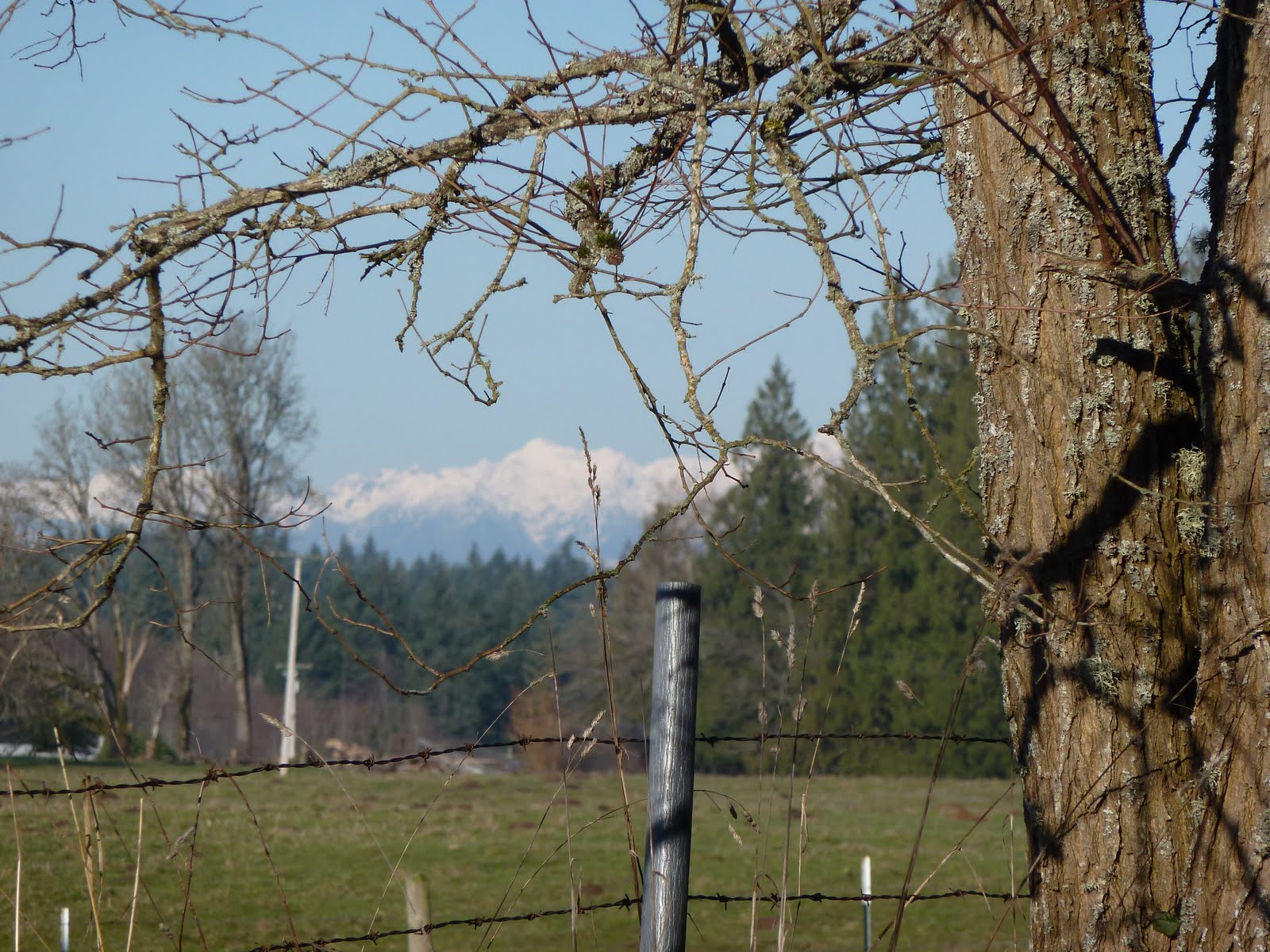
A great view of the Olympics from the Trail.


When I returned home from walking the Chehalis Western Trail, another friend, Maxine, called wanting to go for a walk. Why not? It was such a beautiful day! Lunch was outside sitting in the sunshine soaking up some vitamin D. A picnic in January!

We decided on a beach walk from Burfoot Park. Check out the Olympics this time!


A blue heron was fishing along the shore.


We met Kitty out in her handmade kayak. Kayaking in January, another winter time miracle!


What a fabulous start to the New Year and an incredible January winter day in Olympia, Washington!

Sunday, November 7, 2010

Autumn Leaves and Rainbow

Yes, we get rained on a lot here in Olympia, Washington. Fortunately, it fosters fantastic skies and today while walking the Chehalis Western Trail with my dog, a full rainbow spread across the sky.

I have not been very successful photographing rainbows, but with only my cell phone camera at hand, I gave it a try.


The sunlight came at an angle which highlighted the maple leaves on the trail. As you already know, I love leaves and could not resist another cell phone photo of this spectacular sight.


Close up, it looks like this.


I was reminded of a story Leo Buscaglia, who was a professor at the University of Southern California and beloved speaker, told in one of his speaking engagements about his neighbor's who did not like the look of all the leaves on his front lawn. One day as he was teaching a small class at his home, a neighbor came to his door to complain and request that Leo do something about the leaves because it was a disgrace to the neighborhood. Leo said he loved the leaves (I can relate!). At that moment he told all his students to help him gather all the leaves and bring them into the house. Which they did. The lesson was continued while they sat in the leaves in Leo's living room.
My kind of guy!

I found this last photo very dramatic with the dark sky, a single white cloud, and the dark tree with the moss lit by the sunlight.


Another glorious morning on the Chehalis Western Trail!

Sunday, August 15, 2010

Berry Picking Time

SUNDAY   +   FAMILY   +   SUNSHINE   +   BLACKBERRIES   +  
CHEHALIS WESTERN TRAIL            PERFECT COMBINATION!

Early this morning as Ebony and I traveled the Chehalis Western Trail from Woodard Bay to Martin Way, many people were seen, full buckets in hand and blackish mouths, picking blackberries.

My favorite was this couple and their two children who came on bikes.

The little boy eating from his bucket made me think of times to come with my grandson :)

Thursday, July 1, 2010

Mergansers at Woodard Bay

As we (Ebony, Ginger, and I) were coming back from our morning time on the Chehalis Western Trail, I saw my friends on the Woodard Bay Bridge. You cannot miss Barry because he always has a camera with a huge lens protruding from his head.......at least that is what it looks like from a distance.

Today his wife, Linda, was with him and I was very curious what they were viewing. I stopped (in the middle of the road which sometimes you can do if no one is around) and asked. Linda described how the Mama Mergansers would carry her babies on her back to move them. I thought about stopping to watch, but having skated 10 miles with the doggies my hunger won over watching ducks.

What a treat when Barry sent me an e-mail with photos! Now I wished I had stayed to watch. Barry is not only a great photographer but also a wildlife specialist who shares his knowledge about what you are looking at when you are with him. Even in his e-mails!

"Here are some of the birds we were watching today down by the bridge. The Mergansers nest upstream, then move downstream with their broods within a day of hatching. Once they head out, they don't return, but spend their early days growing up out in Chapman Bay or outer Woodard Bay beyond the trestle."


Barry Troutman
(reproduced with permission from the artist)


Cute, wouldn't you agree?

Sunday, May 2, 2010

Fringecup All Over the Trail

Fringecup is a native plant that is profusely blooming along the Chehalis Western Trail in Olympia, Washington.


It has fuzzy heart shaped leaves, and spikes of greenish-white to reddish flowers. Believe it or not, gardeners, this plant is slug resistant! Maybe we should intersperse it with our veggies?

Occasionally fringecup will spread aggressively, and during mild winters it is evergreen. Might make a great ground cover, what do you think?

Up close

Monday, April 19, 2010

Native Cherries on the Trail

Those of you who travel the Chehalis Western Trail in Olympia, Washington, might recognize this spot. If you do, and you like cherries, bring a ladder this summer and a delight awaits.

Ebony seems to get in every photo!

These blooming trees are the native cherry also known as Bitter Cherry. It is not commonly available from nurseries, garden stores and other plant dealers and distributors.

You are looking at a mature grove of who knows how many years?


General Characteristics:

The Bitter cherry (Prunus emarginata) is a native, deciduous shrub, four to twelve feet high, or sometimes a small tree up to thirty feet high. The leaves are oblong to oval, fine toothed, and rounded at the tip. The flowers are fragrant, blooming between April and May, in clusters of five to twelve. The bark has a generally smooth dark brown surface marked by horizontal light gray interrupted hands and by rows of oblong orange colored lenticels.

Interesting Facts:

Several native North American tribes used bitter cherry to treat a variety of complaints. An infusion of the bark was used in the treatment of tuberculosis. A decoction of the root and inner bark was taken daily as a treatment for heart troubles. An infusion of the bark, combined with crab apple, was used as a cure all tonics in treating colds and various other ailments. An infusion of this species’ rotten wood was used as a contraceptive.

Saturday, April 17, 2010

Stunning Purplish-Pink Trillium

Even though I was only equipped with my phone camera, I could not resist recording this beautiful specimen I found today on the Chehalis Western Trail, my favorite walking path.


Purple-Pink Trillium


This photograph does not reflect the exact color, but the color here is rather striking too, wouldn't you agree?

Now, the next question is was this Trillium first white and then turned purple? Or is this one of those purple Trillium?

Wednesday, April 7, 2010

Trillium Lane Video

I returned to the Chehalis Western Trail in Olympia, Washington with determination to capture the numerous Trillium on video.

A recap for new people.........

I have been amazed by the numbers of Trillium found in the forest near the Chehalis Western Train Head or End (depending on your perspective) at Woodard Bay. In my previous post I captured some of the Trillium with my camera. I have a short video capability on my camera and have been playing with that feature. For those Trillium lovers, I hope you can appreciate the spectacle of Trillium along the trail. In addition, I am expanding my learning curve by posting this video. Here's to the adage to learn something new every day!

Some interesting facts about the Trillium:


The Trillium is often the first wildflower noticed by casual walkers; other spring wildflowers are much less apparent.


In western North America, a typical species is Trillium ovatum (Western Trillium) also with white flowers, that slowly turn into a shade of purple in the middle of spring.


Picking Trillium for their flower can seriously injure the plant. The three leaves (more correctly leafy bracts) below the flower are the plant's only ability to produce food stores and a picked trillium can take many years to recover. For this reason in many areas, e.g. Michigan, New York, Wisconsin, Minnesota, and Washington, it is illegal to pick and/or transplant trilliums from public lands without a permit from the State.


Trillium is one of many plants whose seeds are spread by ants and mice. At maturity, the base and core of the Trillium ovary turns soft and spongy. Trillium seeds have a fleshy organ called an elaiosome that attracts ants. The ants extract the seeds from the decaying ovary and take them to their nest, where they eat the elaiosomes and put the seeds in their garbage, where they can be protected until they germinate. They also get the added bonus of growing in a medium made richer by the ant garbage.


I wish it were longer, but I hope you enjoy!

Sunday, April 4, 2010

Heron's Nesting

On February 25th, I blogged about the nesting grounds of the heron's at Woodard Bay near the Chehalis Western Trail and took a photo from my camera phone which turned out rather favorably.


Recently I had one of those sychronistic moments when I wanted to view heron's nesting before they closed the trail. The sign says the trail closes on April 1st; it was April 3rd but the gate was wide open.

Now, you must use a bit of creative viewing of these next cell phone photos as EVERY NEST has a heron in it.

Can you see them?

See their heads sticking out of the nests?


I was totally mesmerized! Then I thought I was going to get busted as a ranger came down the trail. Lucky for me he was checking for any people on the trail before he locked the gate. Barry told me about the rookery, the name used for the nesting grounds. The one here at Woodard Bay is the largest in Washington!

Talk about being in the right place at the right time!


Some interesting facts regarding the herons and their nests.

Usually, nests are about 1 metre in diameter and have a central cavity 10cm deep with a radius of 15cm. This internal cavity is sometimes lined with twigs, moss, lichens, or conifer needles.

Great Blue Herons normally nest near the tree tops. In colonies made up of several species, they will take possession of the top of the tree and leave the lower branches to other species.

In the spring, males and females reach the nesting grounds at about the same time. Males settle usually where there are nests from former years. Each male then defends his territory in the tree where he plans to build a new nest or restore an old one. From that site, males put on grand displays and shriek loudly when females approach them. New mates are chosen each year. Birds aged two years or more mate almost immediately upon arrival, usually at the nest or, when one is not available, on a branch.

The building of the nest soon follows. The male gathers nest-building materials around the nest site, from live or dead trees, from neighbouring nests, or along the ground, and the female works them into the nest. Ordinarily, a pair takes less than a week to build a nest solid enough for eggs to be laid and incubated. Construction continues during almost the entire nesting period. Twigs are added mostly when the eggs are being laid or when they hatch.

Most female herons lay from three to five eggs in April. Incubation, which is shared by both partners, starts with the laying of the first egg and lasts about 28 days. Males incubate during the days and females at night.
Friday, April 2, 2010

Results of Second Nature's Rorschach Test


What do you see?

For those of you inclined to take the Nature's Rorschach test,
here is the result:

A PROFILE OF AN APE IN CONTEMPLATION


Do you see it?

The line coming down from the top is his forehead which feeds into the outline of his profile. He even has his paw raised against his face in a contemplative mood. He definitely is a happy character!

Do you see it now?

Anyone not familiar with a Rorschach Test here is some information:

The Rorschach test (also known as the Rorschach inkblot test or simply the Inkblot test) is a psychological test in which subjects' perceptions of inkblots are recorded and then analyzed using psychological interpretation, complex scientifically derived algorithms, or both. Some psychologists use this test to examine a person's personality characteristics and emotional functioning.

It is similar to finding images in clouds or in splotches of paint with or without the psychological interpretations.

Thursday, April 1, 2010

Another Nature Rorschach Test

About a week or so ago, I posted an image from my walk along the Chehalis Western Trail in Olympia, Washington. I called it Nature's Rorschach test because the image of the cut tree reminded me of a Rorschach test. At that time, I saw a face. Today, from a different angle the tree stump took on a different image.

What do you see?


For those of you who do not know what a Rorschach test is, I let me explain.

The Rorschach test (also known as the Rorschach inkblot test or simply the Inkblot test) is a psychological test in which subjects' perceptions of inkblots are recorded and then analyzed using psychological interpretation, complex scientifically derived algorithms, or both. Some psychologists use this test to examine a person's personality characteristics and emotional functioning.

It is similar to finding images in clouds or in splotches of paint with or without the psychological interpretations.

Stay tuned for the results of the New Nature's Rorschach Test

Tuesday, March 23, 2010

Photos Along The Trail

On a daily basis, I walk the Chehalis Western Trail in Olympia, Washington with my buddy, Ebony. She does that "happy dog" trot with occassional time off to sniff. I, in turn, have been enjoying the budding of spring and have shared this in previous posts.

Today was an outstanding day for taking photographs, but unfortunately I left my camera at home. Next best thing, the phone camera.

The native Trillium are out and I found lovely specimens. I also enjoyed the curling of the fern fronds.

The phone photo gallery:


Monday, March 22, 2010

The Grace of the Fern

Today as I walked the Chehalis Western Trail in Olympia, Washington, I was drawn to the curling of the fronds of the ferns. They are so graceful!


The ferns along the trail are Sword Fern and Lady Fern.

Sword Fern


Lady Fern


A few interesting facts about ferns:

Ferns are ancient plants that developed before flowering plants. A fern does not produce seeds directly, but rather develops spores that grow in cases, called sori, generally appearing as dots on the backs of fertile leaves. Rows of orange-brown shield-covered sori are easily visible on the backs of the fertile fronds of sword ferns.

The spores, when released, do not develop directly into ferns, but rather grow into a tiny leaf-like structure called a prothallium. The prothallium produces eggs and sperm that unite to generate new ferns. It takes several years for a fern to grow from a spore.

The leaves and roots of ferns grow from underground rhizomes that can be extensive and live for many years. Though the leaves, or fronds, of many ferns die back in winter, the rhizome survives to sprout new fronds in spring.

Friday, March 12, 2010

Nature's Rorschach test

The Rorschach test (also known as the Rorschach inkblot test or simply the Inkblot test) is a psychological test in which subjects' perceptions of inkblots are recorded and then analyzed using psychological interpretation, complex scientifically derived algorithms, or both. Some psychologists use this test to examine a person's personality characteristics and emotional functioning.

It is similar to finding images in clouds or in splotches of paint with or without the psychological interpretations.

As I was walking the Chehalis Western Trail in Olympia, Washington with my favorite companion, Ebony, I came upon this tree stump and immediately saw an image.

What do you see?

My answer in the next post. Stay tuned...........


Sunday, March 7, 2010

New Bloom on the Trail

It is exciting to walk the Chehalis Western Trail on a daily basis and watch for the new blooms of spring.

My master gardener friend, Janet Mandell, has been assisting me in identifying the different native plants.

The newest bloom is the Coltsfoot which is also called Sweet Coltsfoot and Palmate Coltsfoot. It blooms from March through to July in wet or marshy ground in woods and in roadside ditches. You will find it mostly west of the Cascades from Alaska to California and found east to Michigan and Massachusetts.

This patch of Coltsfoot I found blooming happily in a boggy section of the Chehalis Western Trail in Olympia, Washington.

Saturday, March 6, 2010

Pastural Setting


Large Flock of Canada Goose


For the past few mornings along the Chehalis Western Trail in Olympia, Washington, the honking of the Canada Goose disturbs the quiet of the early morning. An enormous gathering favors this area of pastures and ponds. They are fun to watch take off and land as they fly in formation.

My father-in-law insisted that they are called Canada Goose. I remember saying Canada Geese because it seemed to be the plural form, but he corrected me. What are your thoughts?