Showing posts with label paper. Show all posts

Thursday, January 5, 2012

More Scribbles

I picked up one of Bet Borgenson's book on colored pencil techniques and shared it with my art therapy client who, unfortunately is now immobile due to Parkinson's. I have shared my recent creations at times, but I no longer get her feedback. I shared my woes regarding colored pencils and brought Bet's book and my sketchbook on my last visit.

What I learned is the importance of paper when using colored pencil. Bet showed a cross-section of different papers and how the colored pencil works with each. Returning again to my frustration and challenge with the paper provided in the sketchbook, I scribbled. The last sketches in my sketchbook for the Sketchbook Project 2012 will be done in colored pencil because gluing the watercolor sketches into the sketchbook has made it rather bulky.

This scene was inspired by a vista from my walk on the Chehalis Western Trail not far from my house in Olympia, Washington. I love to watch the seasonal transitions of the ponds and especially like cattails. I am a frequent flier on the Trail.

Wednesday, November 16, 2011

It is Just Paper!

My classic line when I work with people creating art who are critical of their artwork is, "It is just paper, not to worry."

Well this line takes on a new dimension after viewing paper sculptures by Canadian artist Calvin Nicholls.
My good friend and artist, Judi Colwell, introduced me to him.

I use the expression this time as.....
"Oh my gosh, it is just paper!"

There is nothing simple or ordinary about his paper art. Where we would use a piece of paper and a pair of scissors, Calvin uses everything you could possibly think of to carve, cut and rip perfect details onto his creations. The motifs are mostly wildlife and the details are truly amazing. One can not even fathom the time it must have taken to create these masterpieces of art.

Here are two of my favorites:


Be sure to visit his website to see more ASTONISHING JUST PAPER creations.

Sunday, November 6, 2011

Sunday Sketches

Still learning about this Sketchbook Project 2012 process.

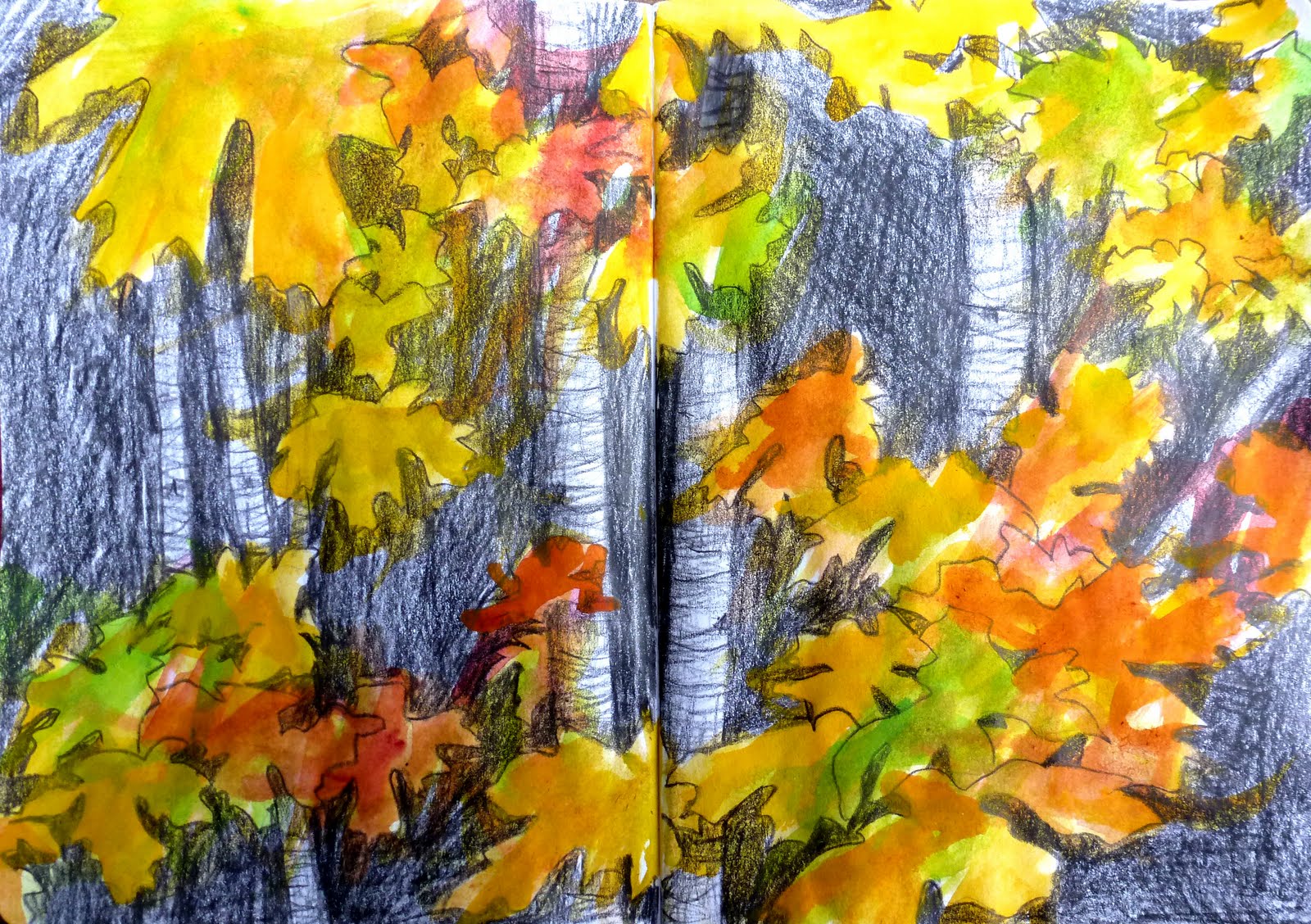
Today's lesson; Joanne verses "the paper."

I wanted to give a blast of color with watercolors to emphasize the leaves' fall color. The paper got saturated and started to shred. Immediately I took out the hair dryer before disaster occurred and I would have to remove another page from the sketchbook.

I remembered that my ink pen leaked through this paper, therefore, I opted for colored pencil to bring out the leaves and trees.

Hey, it worked! Score one for Joanne!


I have to figure out what to do with the next page because it is now wavy from the use of water on this page.

Ah, the challenge continues........

Thursday, December 10, 2009

Mask

I started a new watercolor painting and wanted to be totally free with the background.

The solution; use a mask which is actually a liquid wax that you apply to the paper. When you use a mask, the white paper will remain when the wax is removed with an eraser.....provided you thoroughly covered the area you intended to remain white.

I am planning to paint some lavender in the foreground, but I wanted a colorful background. Masking allowed me the freedom to play with the colors as they flowed on the paper. What fun!

This is what it looks like so far:


Here is a close up view. Can you see the lovely variations of color and color flow that watercolors do so well?

Click on either image for a closer look.


What next?

Back to the drawing board.........

Friday, June 19, 2009

Part 2: Paper's Role in the
Development of Watercolor

Paper has played an important role in the development of watercolor.

China has been manufacturing paper since ancient times. The Arabs learned their secrets during the eighth century. Paper was imported to Europe until the first papermaking mills were finally established in Italy in 1276. A few other mills developed later in other parts of Europe, while England developed its first mills by 1495. However, high-quality paper was not produced in Britain until much later during the eighteenth century.

Since paper was considered a luxury item in these early ages, traditional Western watercolor painting was slow in evolving. The increased availability of paper by the fourteenth century finally allowed for the possibility of drawing as an artistic activity.

Artists like Leonardo da Vinci and Michelangelo began to develop drawings as a tool for practice and for recording information. Albrecht Durer (German, 1471-1528) is traditionally considered the first master of watercolor because his works were full renderings used as preliminary studies for other works. Over the next 250, years many other artists like Peter Paul Rubens (Flemish, 1577-1640), Anthony van Dyck (Flemish, 1599-1641) and Jean Honore Fragonard (French, 1732-1806) continued to use watercolor as a means of drawing and developing compositions.

With the production of higher quality papers in the late eighteenth century, the first national school of watercolorists emerged in Britain. This watercolor tradition began with topographical drawings that proliferated in the late seventeenth and early eighteenth centuries as Britain began to grow as a world power.

These map-like renderings encompassed visual identity of ports of sea, as well as the surrounding landscape. In 1768, influential topographers founded the Royal Academy which encouraged watercolorists to carry the medium beyond their own technical achievements. The most talented watercolorist from this period was Joseph M.W. Turner (English, 1775-1851) who went on to become one of the greatest painters of the nineteenth century. His contemplative landscapes were tremendously influential on dozens of artists during later decades.


View of Arco. 1495.
Albrecht Durer
Watercolour and gouache on watercolor paper
Louvre, Paris, France

Thursday, May 21, 2009

The Spirit of Balance

Getting back into reading Jeanne Carbonetti's book The Tao of Watercolor, I came upon her thoughts in regards to balance in a painting.

She claims that the spirit one brings to the practice of painting is the ability to respond with a fresh outlook to the dynamics of brush, water, and paper. It is not to force anything but to respond to everything---without getting caught up in details too soon, which can be a fatal mistake in painting.

Rembrandt said, "We should view a painting, not 'nose' it."

Jeanne reminds us to see all the space, not just painted space, as being worthy of your attention---and when you think of empty space as being full of potential---that just may be the secret to success in painting as it is in life.

Thoughts to ponder........


Summer Reflections
by Jeanne Carbonetti